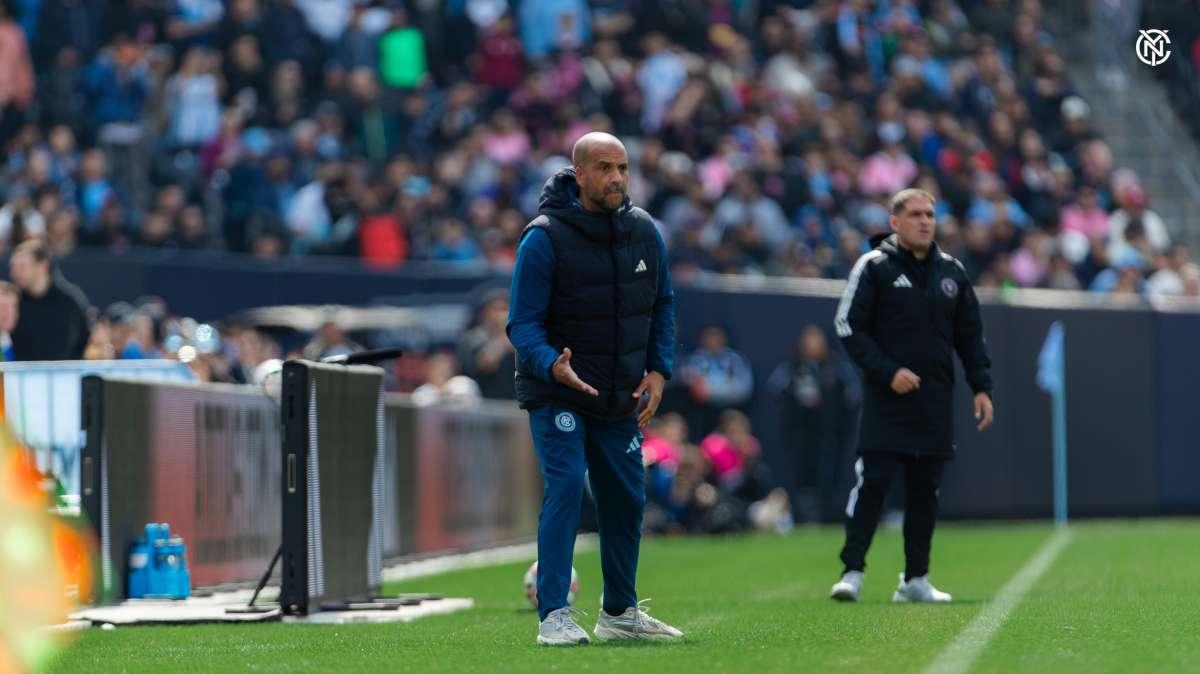
Pascal Jansen refused to wait until halftime when New York City FC began losing control against the New England Revolution. With his team trailing, struggling defensively and facing the possibility of a fifth consecutive defeat, the coach made two substitutions in the 40th minute.
Keaton Parks and Mitja Ilenič entered for Jonny Shore and Tayvon Gray, an unusually early intervention that carried an unmistakable message: the original plan was not working, and NYCFC could not afford to waste more time.
The changes immediately improved the team’s structure. Talles Magno hit the post three minutes later before James Sands equalized from a set piece in first-half stoppage time. New York then created several opportunities after the break and left Gillette Stadium with a 1-1 draw.
One point did not erase every concern, but Jansen’s willingness to react prevented another difficult performance from becoming a damaging defeat.
Jansen Corrected NYCFC’s Shape Before Halftime
Jansen made four changes to the starting lineup that had faced FC Cincinnati, bringing Max Murray, Nico Cavallo, Talles Magno and Shore into the team. The objective appeared to be increasing energy and giving younger players an opportunity during a demanding period.
The plan failed to provide enough control. New England repeatedly found space behind the NYCFC defense, particularly through Peyton Miller’s pace and Jack Harrison’s movement.
Matt Freese produced a spectacular double penalty save to deny Carles Gil, while Sands later cleared Miller’s effort off the goal line. Those interventions delayed the opening goal, but New England eventually moved ahead when Harrison’s cross was returned across the area for Dor Turgeman to finish.
Jansen responded before the situation deteriorated further. Introducing Parks gave NYCFC a midfielder capable of controlling possession, progressing the ball and supporting the attack. Ilenič added mobility on the right and helped stabilize the defensive structure.
Removing a young player such as Shore before halftime was a difficult decision. It risked affecting his confidence, but Jansen prioritized the immediate needs of the team. The substitution should not be interpreted as a final judgment on the midfielder’s potential; it reflected the tactical demands of that specific match.
The improvement was almost immediate. Talles Magno directed a header against the post before the equalizer arrived from a corner. The Brazilian redirected the delivery toward Sands, who reacted first and finished from close range.
NYCFC entered halftime level rather than chasing the game. That difference changed the emotional and tactical direction of the afternoon.
The Changes Offered a Possible Blueprint for the Playoff Run
New York became the more dangerous team during significant periods of the second half. Parks forced Matt Turner into a difficult save with a powerful volley, Fernández Mercau tested the goalkeeper twice and Agustín Ojeda delivered several threatening crosses.
The visitors did not find a winning goal, but their improvement demonstrated what the midfield can produce when the balance is correct. Parks gave Sands more freedom, while Ilenič helped the team advance down the right without leaving the same defensive spaces exposed.
The performance also showed the importance of proactive coaching. NYCFC had recently surrendered a two-goal advantage against Philadelphia before conceding a stoppage-time winner to Cincinnati. In both matches, promising periods were undermined by an inability to control changing momentum.
Against New England, Jansen acted before the match escaped. The decision did not guarantee victory, but it allowed NYCFC to remain competitive and end a four-game losing streak across MLS and Leagues Cup.
The challenge is determining whether the revised structure can work from the opening whistle. Jansen cannot depend on emergency substitutions every week, especially with an injury list that already limits his bench.
Parks appears capable of playing a larger role alongside Sands, while Ilenič’s athleticism can help provide width and defensive recovery. Jansen must now decide whether those qualities should be included in the starting lineup against Toronto.
The coach also needs to preserve opportunities for Shore, Cavallo, Murray and the other young players pushed into the rotation. Their development remains important, but they require a stable structure around them rather than being asked to solve the team’s problems independently.
The Toronto match will reveal whether the New England adjustments represented a genuine breakthrough or merely a temporary correction. Another slow start would suggest NYCFC’s difficulties are deeper than personnel selection.
For one afternoon, however, Jansen demonstrated the decisiveness required during a playoff race. He recognized the failure of his original approach, accepted responsibility and changed it before halftime.
That intervention may prove more important than the single point NYCFC collected. It offered a possible route away from the recent decline—and showed that Jansen is prepared to make uncomfortable decisions to protect the season.
Other news - News








Other news
- 07:58 Carles Gil and Peyton Miller: New England’s Duo to Watch Before the Playoffs
- 02:30 Cavan Sullivan’s MLS Rise: Is Philadelphia’s Young Star Ahead of Schedule?
- 01:30 Luighi Wins Again: Is NYCFC’s Next Attacking Star Emerging?
- 00:30 NYCFC vs. Red Bull in the Playoffs? A New York Derby With Everything to Lose
- 23:30 Lewandowski vs. Müller: A Bayern Reunion With Huge MLS Stakes
- 23:00 Nashville SC Could Break Messi’s Miami Record—But There’s a Catch
- 22:57 Messi’s MLS MVP Three-Peat: Can Anyone Stop Him in 2026?
- 22:51 Luighi Does It Again: NYCFC Forward Claims Another Monthly Award
- 17:00 Playoff Math: What NYCFC Needs to Do Down the Stretch
- 15:00 The Botafogo Connection: How a Brazilian Club's Debts Are Funding NYCFC's Business
- 13:00 Is Hannes Wolf's Time in New York Coming to an End?
- 21:00 The Shift: How NYCFC Snapped Out of Its Funk in Salt Lake City
- 18:57 Six Games Left: NYCFC's Rendezvous With Destiny at Yankee Stadium
- 15:30 The Quiet Architect: Agustín Ojeda's Fingerprints All Over NYCFC's Win
- 14:30 From Disappointment to Dominance: How NYCFC Answered Their Midweek Setback
- 13:30 The Wall: Matt Freese's Masterclass Anchors NYCFC's Win Over Real Salt Lake
- 12:30 The Hero Returns: Alonso Martínez Back on the Pitch as NYCFC Beats Real Salt Lake
- 11:28 New York City FC Grind Out 2-0 Win at Real Salt Lake Despite Slow Start
- 18:00 NYCFC Turn Their Focus to New England: What Must Improve After Nashville?
- 16:30 Can NYCFC Keep Competing Until Moralez, Parks and Hannes Wolf Return?
- 15:00 NYCFC 0-0 Nashville: One Point Gained or Two Points Lost?
- 21:30 NYCFC Defend With Character, but the Attack Still Needs More Ruthlessness
- 20:00 Aiden O’Neill Makes His Mark for NYCFC: A Valuable Defensive Option for Pascal Jansen
- 18:30 NYCFC Show Their Depth: Seven Players Missing, Yet Another Clean Sheet
- 17:00 Pascal Jansen’s NYCFC Rotation Worked Defensively — But Questions Remain in Attack
- 15:30 Nico Fernández Mercau Sets the Tone: Why His Pressing Is Crucial for NYCFC
- 14:00 Bénie Traoré and Luighi Show Early Chemistry: NYCFC’s New-Look Attack Is Taking Shape
- 23:00 Luighi’s Next Step at NYCFC: From Rising Star to Consistent MLS Threat
- 22:00 Raul Gustavo’s Costly Scare: What NYCFC Must Learn From the Mukhtar Chance
- 21:00 Malachi Jones Nearly Wins It for NYCFC: Has He Earned More Minutes?
- 20:00 Agustín Ojeda Shines for NYCFC: Is a Breakout Run About to Begin?
- 19:00 NYCFC’s Biggest Problem Is Clear: Who Is Going to Score the Goals?
- 18:00 Matt Freese Saves NYCFC Again: Is He Becoming the Team’s Most Important Player?
- 17:28 NYCFC Held to 0-0 Draw by Nashville SC at Yankee Stadium
- 18:30 NYCFC Need Their Identity Back: What Happened to the Aggressive, Fearless Team Fans Expected?
- 17:00 What Should NYCFC’s Real Goal Be Now: MLS Cup, a Playoff Run or Building for 2027?
- 15:30 Nashville and New England Could Define NYCFC’s Season — The Next Two Games Suddenly Feel Massive
- 14:00 Can NYCFC’s Young Core Carry the Club Into Its Next Era?
- 20:00 NYCFC’s Next Transfer Window Could Define the Future: Three Positions New York Must Reinforce
- 18:30 Is Pascal Jansen Building the Right NYCFC for the Future? The Answer Is Still Complicated
- 17:00 NYCFC Need a Killer Instinct: Good Performances Are No Longer Enough
- 15:30 From MLS Cup Dreams to Playoff Anxiety: Where NYCFC Really Stand Right Now
- 14:00 Can NYCFC Still Win MLS Cup in 2026? Five Reasons to Believe — and Five Reasons to Worry
- 19:00 NYCFC’s Defense Has Talent — So Why Does It Still Look So Vulnerable?
- 17:30 The Keaton Parks Question: Is He Still Essential to NYCFC’s Midfield Future?
- 16:00 Without Alonso Martínez, NYCFC Need a New Source of Goals — Who Is Ready to Step Up?
- 14:30 Luighi’s Big NYCFC Opportunity: Can the Brazilian Prospect Become New York’s Next Starting Striker?
- 13:00 NYCFC’s Five-Game Winless Run Is Becoming a Real Problem — Can Pascal Jansen Fix It Before the Slide Gets Worse?
- 04:00 NYCFC’s Injury Crisis Is Exposing a Bigger Question: Is the Roster Deep Enough to Compete for MLS Cup?
- 03:00 NYCFC Keep Dropping Leads — Is This Becoming a Mental Problem?
- 02:00 Pascal Jansen Under Pressure: Are His In-Game Decisions Costing NYCFC Points?
- 01:00 Matt Freese Keeps Saving NYCFC — But New York Cannot Keep Asking Its Goalkeeper to Rescue Every Game
- 00:01 Nico Fernández Mercau Is Becoming NYCFC’s Most Important Attacking Player