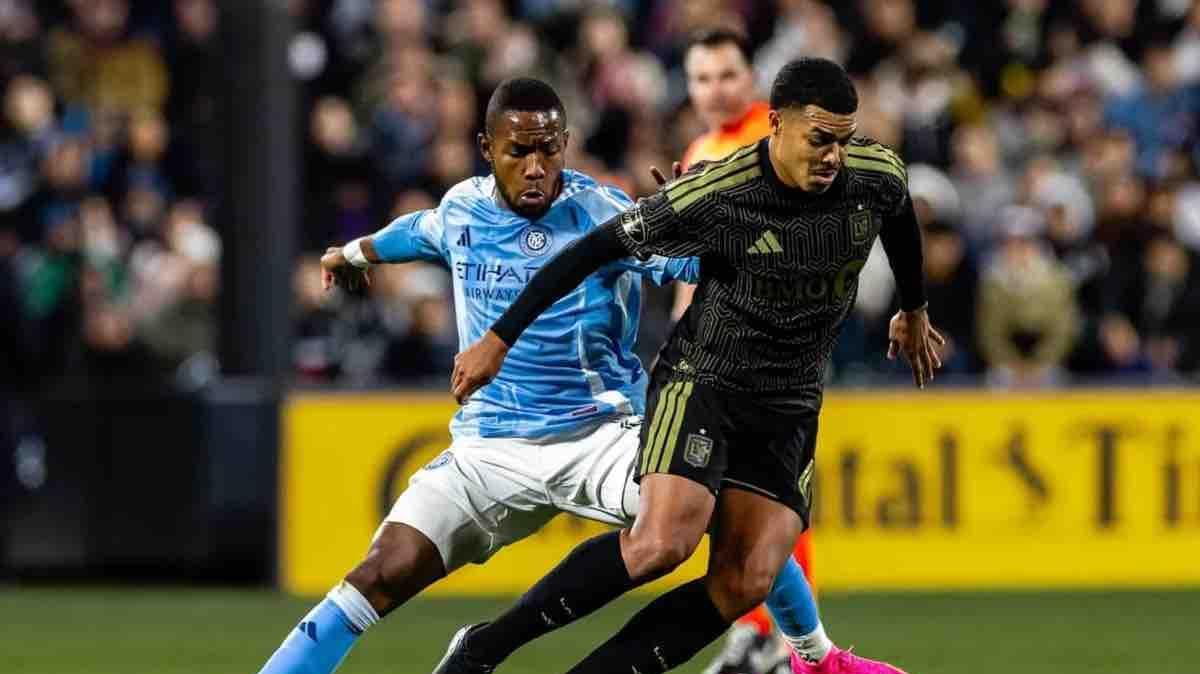
New York City FC controlled much of Saturday's encounter against Los Angeles FC, but the final score once again highlighted a frustrating weakness.
The Boys in Blue enjoyed approximately 66% possession and attempted 13 shots during the 1-1 draw at Citi Field.
Yet despite those numbers, New York generated only around 0.70 expected goals.
The contrast between possession and attacking productivity offers an important explanation for NYCFC's recent difficulties.
Pascal Jansen's team can control the ball and establish territory, but turning that control into clear scoring opportunities remains a challenge.
With the Eastern Conference playoff race entering its final stretch, the problem could prove costly.
NYCFC's Possession Advantage Failed to Produce Enough Chances
Possession statistics can be misleading when considered in isolation.
A team may dominate the ball without consistently threatening the opposition goalkeeper.
That was particularly evident during the first half against LAFC.
NYCFC circulated possession and attempted to create openings through the wide areas, but Hugo Lloris remained largely untroubled.
The visitors, meanwhile, threatened through Son Heung-min and Denis Bouanga whenever they recovered possession.
Leo Walta eventually gave LAFC the lead through an exceptional free-kick in first-half stoppage time.
New York improved significantly after halftime.
Gray forced Lloris into an impressive save, and Perea equalized with a header from Fernández Mercau's corner.
However, the home side could not find the second goal.
The problem was not simply the number of shots.
It was the quality of the opportunities.
What 0.70 Expected Goals Says About New York's Attack
Expected goals, commonly known as xG, estimate the likelihood that a scoring opportunity will result in a goal.
The calculation considers factors such as shooting position, angle, and the type of chance.
An xG total of approximately 0.70 indicates that NYCFC's attempts collectively represented less than one expected goal according to the statistical model used.
That does not mean New York was incapable of scoring more than once.
It means the team struggled to generate consistently high-probability chances.
Several efforts came from distance or difficult positions.
The clearest opportunities included Gray's powerful shot and Perea's successful header.
The statistics reinforce an important point.
NYCFC needs to improve the quality of its attacking situations rather than simply increasing the number of attempts.
Fernández Mercau Cannot Carry the Entire Attack
Nicolás Fernández Mercau remains one of New York's most influential attacking players.
Against LAFC, he delivered the corner that allowed Perea to equalize.
He also attempted to score himself, forcing Lloris into action during the closing stages.
But NYCFC cannot depend on the Argentine to provide every decisive contribution.
The attacking department must become more balanced.
Hannes Wolf can offer movement and creativity.
Agustín Ojeda has demonstrated his ability to provide assists.
Luighi offers a physical presence and attacking energy.
Talles Magno and Bénie Traoré can introduce different characteristics from the bench.
The challenge is making these players function as a coordinated unit.
Too often, attacking movements appear disconnected from the team's buildup.
The forwards need earlier service, while midfielders must recognize opportunities to attack space.
The team also needs greater composure around the penalty area.
How Pascal Jansen Can Fix NYCFC's Scoring Problems
There is no single solution to New York's attacking difficulties.
However, several tactical adjustments could improve the team's efficiency.
First, NYCFC must increase the speed of its attacking transitions.
When possession is recovered, moving the ball forward quickly can prevent opponents from establishing a compact defensive structure.
Second, the team needs more coordinated movement inside the penalty area.
One player attacking the near post, another moving toward the far post, and a midfielder arriving late can create multiple options for the player delivering the ball.
Third, NYCFC must continue improving its set pieces.
Perea's equalizer against LAFC demonstrated how important dead-ball situations can become when open-play opportunities are limited.
Finally, Jansen must find a better balance between maintaining possession and taking attacking risks.
Controlling the ball is useful only when it helps create dangerous situations or limits the opponent's opportunities.
The 1-1 draw against LAFC offered encouraging signs, particularly during the second half.
But it also exposed the limitations that have affected NYCFC throughout its recent winless run.
With four games remaining, New York cannot afford to dominate possession without collecting points.
The Boys in Blue need goals.
And those goals must come from a more effective collective attack.
Other news - News









Other news
- 22:13 NYCFC's Citi Field Nightmare: Why New York Cannot Win at Home
- 20:11 Andrés Perea Saves NYCFC With Crucial Goal Against LAFC
- 19:22 Pascal Jansen Under Pressure as NYCFC's Playoff Hopes Fade
- 15:42 NYCFC Playoff Crisis: Four Games Left to Save the Season
- 14:25 NYCFC vs LAFC 1-1: Perea Saves New York in Dramatic Draw
- 00:12 Son and Bouanga vs NYCFC: Can New York Stop LAFC's Stars?
- 23:13 NYCFC Needs Nico Fernández Mercau to Save Its Playoff Dream
- 23:10 NYCFC vs LAFC: Is New York's Playoff Dream on the Line?
- 22:00 NYCFC’s Post-World Cup Challenge Could Shape Its Future
- 21:21 Knicks Start 0-3: Should Fans Worry About the Real Warning Signs?
- 20:30 Etihad Park Opening Date: NYCFC’s New Era Starts Here
- 19:00 NYCFC Schedule Shake-Up: Three Big Dates Fans Must Know
- 17:30 Luighi’s NYCFC Future: The Clause That Could Change Everything
- 16:00 Fernández Mercau Gives NYCFC a Weapon Defenses Cannot Ignore
- 14:30 Agustín Ojeda’s Assist Surge Reveals NYCFC’s Creative Weapon
- 13:00 Luighi Wins Again: NYCFC’s Rising Forward Makes His Case
- 07:00 Alonso Martínez Returns—and NYCFC Face a Big Attack Decision
- 07:58 Carles Gil and Peyton Miller: New England’s Duo to Watch Before the Playoffs
- 02:30 Cavan Sullivan’s MLS Rise: Is Philadelphia’s Young Star Ahead of Schedule?
- 01:30 Luighi Wins Again: Is NYCFC’s Next Attacking Star Emerging?
- 00:30 NYCFC vs. Red Bull in the Playoffs? A New York Derby With Everything to Lose
- 23:30 Lewandowski vs. Müller: A Bayern Reunion With Huge MLS Stakes
- 23:00 Nashville SC Could Break Messi’s Miami Record—But There’s a Catch
- 22:57 Messi’s MLS MVP Three-Peat: Can Anyone Stop Him in 2026?
- 22:51 Luighi Does It Again: NYCFC Forward Claims Another Monthly Award
- 17:00 Playoff Math: What NYCFC Needs to Do Down the Stretch
- 15:00 The Botafogo Connection: How a Brazilian Club's Debts Are Funding NYCFC's Business
- 13:00 Is Hannes Wolf's Time in New York Coming to an End?
- 21:00 The Shift: How NYCFC Snapped Out of Its Funk in Salt Lake City
- 18:57 Six Games Left: NYCFC's Rendezvous With Destiny at Yankee Stadium
- 15:30 The Quiet Architect: Agustín Ojeda's Fingerprints All Over NYCFC's Win
- 14:30 From Disappointment to Dominance: How NYCFC Answered Their Midweek Setback
- 13:30 The Wall: Matt Freese's Masterclass Anchors NYCFC's Win Over Real Salt Lake
- 12:30 The Hero Returns: Alonso Martínez Back on the Pitch as NYCFC Beats Real Salt Lake
- 11:28 New York City FC Grind Out 2-0 Win at Real Salt Lake Despite Slow Start
- 18:00 NYCFC Turn Their Focus to New England: What Must Improve After Nashville?
- 16:30 Can NYCFC Keep Competing Until Moralez, Parks and Hannes Wolf Return?
- 15:00 NYCFC 0-0 Nashville: One Point Gained or Two Points Lost?
- 21:30 NYCFC Defend With Character, but the Attack Still Needs More Ruthlessness
- 20:00 Aiden O’Neill Makes His Mark for NYCFC: A Valuable Defensive Option for Pascal Jansen
- 18:30 NYCFC Show Their Depth: Seven Players Missing, Yet Another Clean Sheet
- 17:00 Pascal Jansen’s NYCFC Rotation Worked Defensively — But Questions Remain in Attack
- 15:30 Nico Fernández Mercau Sets the Tone: Why His Pressing Is Crucial for NYCFC
- 14:00 Bénie Traoré and Luighi Show Early Chemistry: NYCFC’s New-Look Attack Is Taking Shape
- 23:00 Luighi’s Next Step at NYCFC: From Rising Star to Consistent MLS Threat
- 22:00 Raul Gustavo’s Costly Scare: What NYCFC Must Learn From the Mukhtar Chance
- 21:00 Malachi Jones Nearly Wins It for NYCFC: Has He Earned More Minutes?
- 20:00 Agustín Ojeda Shines for NYCFC: Is a Breakout Run About to Begin?
- 19:00 NYCFC’s Biggest Problem Is Clear: Who Is Going to Score the Goals?
- 18:00 Matt Freese Saves NYCFC Again: Is He Becoming the Team’s Most Important Player?
- 17:28 NYCFC Held to 0-0 Draw by Nashville SC at Yankee Stadium